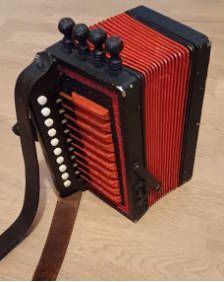
The "Kniri BluesÖrgeli" & the KNIRI 221 System
An accordion in blues and jazz?
What might sound impossible has become a reality, thanks to a discovery in music theory and masterful craftsmanship.
Classic diatonic accordions (such as Cajun accordeons or melodeons) reach their limits when it comes to the blues. In search of a solution,
I made a fundamental discovery in 2001: an expansion of the circular and spiral note arrangement based on the circle of fourths.
While a standard 8-note diatonic scale ends after one octave—only to begin anew for the next, and so on— the "221 scale"
I developed (based on a whole-tone, whole-tone, semitone interval sequence) continues seamlessly.
It is structured as a spiral: the sequence only repeats after 36 notes—though at a much higher octave.
For the visionary mechanical realization of this discovery,
I am indebted to a brilliant local expert: Hans Seiler, an experienced accordion tuner and repair technician from Teufenthal, took on my idea.
Following my precise specifications, he meticulously retuned and modified the instruments.
At its core, it remains diatonic, but it is strategically expanded with key chromatic notes via the "221" circle-of-fourths spiral.
This specific note arrangement allows me to fluidly play blues scales, "blue notes," and jazz chords across multiple registers—
all while preserving the instrument’s characteristic percussive quality.
It is a unique system that bridges Swiss craftsmanship with innovative harmonic theory!
1. The Basic Principle: Bisonoric & Diatonic Much like a harmonica (blues harp) or a classic diatonic accordion, each of the 10 buttons produces two different notes: Pushing: The bellows are compressed. Pulling: The bellows are expanded.
2. The "2-2-1" Spiral in the Circle of Fourths While a standard single-row accordion is usually limited to a single major key, the Kniri system employs a consistent step-pattern (2-2-1) arranged along the circle of fourths: The 2-2-1 sequence: These numbers represent the pitch intervals (in semitone steps) between the notes produced when pushing and pulling. Chromatic expansion: Although the instrument remains fundamentally diatonic, this spiral arrangement incorporates the specific intermediate notes required for blues scales and "blue notes" (such as the minor third or minor seventh).
Five keys on one instrument: The uniform pattern allows for the shifting of fingerings, enabling the player to perform blues in five different keys on a single 10-button instrument.
3. Chords and Accompaniment The notes are positioned such that pressing adjacent buttons simultaneously automatically produces characteristic jazz and blues chords: When pushing (e.g., in the key of G): Chords such as G7, Dm7, F7, or diminished chords (Bdim) are produced. When pulling (e.g., in the key of G): Chords such as Am7, C7, Gm7, or Bb7 are produced. Bass buttons: On the left-hand side, there are typically two bass/chord buttons (as is common with the Cajun accordion) that support the rhythm, while the right hand plays melodies and multi-note chord riffs.
4. Tuning variants Circular-Kniri (hybrid tuning): In this configuration, two notes (button 1 on the push and button 3 on the pull) are uned a semitone lower, allowing for playing in a specific key across a range of 2 1/2 octaves.
1 Row Diatonic Accordion
BluesÖrgeli KNIRI 221
It allows you to play 5 Major (Mixolydian) and 5 Minor (Natural/Aeolian) scales/chords
F# A C E G Bb D F Ab C push F#m7b5, Am7, C7 , Em7b5, Gm7, Bb7, Dm7b5, Fm
E G B D F A C Eb G Bb pull Em7, G7, Bm7b5, Dm7, F7, Am7b5, Cm7, Eb
Circular-Kniri: The lower half follows the standard Circular sequence, while the upper half integrates elements of the Kniri 221 system.
Button 1 push and 3 pull = 1 semitone lower than Kniri 221
BluesÖrgeli Circular-Kniri Tuning in F (Dm)
F A C E G Bb D F Ab C push Fmaj7, Am7, C7 , Em7b5, Gm7, Bb7, Dm7b5, Fm
E G Bb D F A C Eb G Bb pull Em7, G7, Hm7b5, Dm7, F7, Am7b5, Cm7, Es
blue notes , the minor seventh and minor third (Eb and Ab)
B*englisch = H deutsch, Bb englisch = B deutsch
----------------------------------------------------------------------------
Kniri 221 variations for playing within the circle of fourths
221.2212212212212212---pitches, steps
Kniri 221-1
A C E G Bb D F Ab C Eb - push
G B* D F A C Eb G Bb Db - pull
1.221.221221221221221---pitches, steps
Kniri 221-2
G B* D F A C Eb G Bb Db- push
F# A C E G Bb D F Ab C - pull
21.221.22122122122122---pitches, steps
Kniri 221-3
E G Bb D F Ab C Eb Gb Bb- push
D F A C Eb G Bb Db F Ab - pull